Latest thinking
Follow me on Linkedin to be notified of my latest articles, podcasts and research papers as soon as they are published.
Follow

What happens when partners no longer feel part of the same partnership? What has happened to our collegiality? These are questions I am often asked when working with leaders of law, accounting, and consulting firms. Their organisations may be financially successful, but something has changed. Partners know fewer of their colleagues, leadership feels increasingly remote, and the shared understanding that once held the partnership together seems less certain.
Sometimes these concerns emerge after a merger or a period of rapid growth. Sometimes they reflect the changing expectations of younger professionals, the influx of new colleagues who differ from them, or the consequences of hybrid working. Whatever the immediate cause, the underlying concern is often the same: what has happened to our collegiality?
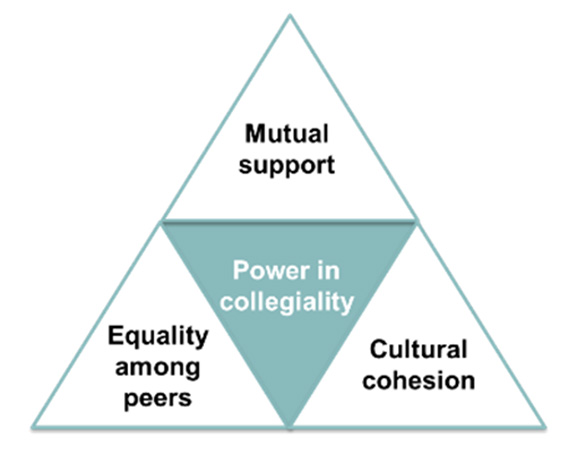
In my new chapter, “Collegiality in Contemporary Professional Service Firms”, in The Routledge Companion to the Professions and Professionalism, I explore what collegiality actually means and why it matters. Drawing on more than 500 interviews with professionals, I identify three interconnected elements: mutual support, equality among peers, and cultural cohesion.
Together, these factors help explain how successful professional partnerships function. Partners support one another because they recognise their shared interests and responsibilities. They expect to be treated as equals, even when they delegate considerable authority to their leaders. And they share enough assumptions about how partners should behave to work collectively without depending excessively on formal management controls.
When these elements reinforce one another, collegiality can be extraordinarily powerful.

But collegiality is not necessarily benign. Mutual support can become an excuse for avoiding difficult conversations with underperforming colleagues. Equality among peers can obstruct necessary decisions and undermine leadership. Cultural cohesion can exert powerful pressure to conform, excluding those who do not fit established expectations.
One senior professional I interviewed described the culture of his accounting firm rather vividly:
“We are like a wolf pack. We hunt together, help raise each other's children - until one of us stumbles and we turn and eat him.”
It is a somewhat uncomfortable image, but captures something fundamental about collegiality. The solidarity that binds partners together can be extraordinarily powerful, yet their membership of the collective may ultimately be conditional.
These tensions become particularly important as professional firms grow, diversify, and become more complex. Leaders may introduce more formal management systems, but these can weaken the relationships that make partnerships distinctive. Meanwhile, attempts to preserve a strong traditional culture may reinforce exclusionary practices that are increasingly difficult to justify.
So revitalising collegiality cannot simply mean restoring the partnership culture of the past. Some elements may be worth preserving, but others need to evolve.
When I work with partnership groups, I find that partners often recall a time in the past when they valued the collegiality that bound them together but are now because colleagues tolerate behaviour that contradicts these values, or they may feel increasingly disconnected from their leaders. These cultural problems go to the heart of how leadership works in professional partnerships. As I explain in my research on collective leadership, the entire partnership is implicated in the leadership dynamics, whether individual partners recognise it or not.
In my keynotes and facilitated partnership workshops, I sometimes use my research to help partners explore the following questions:
What holds your partnership together?
What unites you?
What divides you?
The answers are seldom straightforward. But understanding what sustains collegiality, what threatens it, and what partners themselves are prepared to do about it is vital to leading a partnership through challenging times.
I explore these questions with professional partnerships through keynote speeches, facilitated workshops, and advisory work. Find out more about my advisory work and speaking engagements.
Follow me on Linkedin to be notified of my latest articles, podcasts and research papers as soon as they are published.
Follow